
Search Orangetown Residents by Record
Begin with the record that fits the question. An address or owner name belongs in the Town tax search. A past owner belongs in the Rockland County deed index. A court connection belongs in one of the separate New York court systems. Older household research belongs in the Rockland Room rather than a current portal. Each source describes a different relationship to Orangetown, so keep owner, subscriber, court party, licensee, and occupant separate in your notes.
A strong match has two independent anchors, such as a name plus a parcel, spouse, street, age, or dated court context. A single tax result can be useful, but it does not prove who sleeps at that address. Renters, unlisted subscribers, protected voters, and household members may not appear in any public index. Record the source date before treating a result as a current connection.
- Run a known address, owner surname, or Tax Map number through the Town’s BAS tax search and write down the parcel label and tax year.
- Use RocklandGIS to check the parcel’s mapped setting, boundaries, roads, and nearby municipal layers.
- When title matters, open the most recent deed in the County Clerk’s Cott land-record route and compare grantor, grantee, and legal description.
- For a historical household, ask the Rockland Room for the cross-reference directories, telephone books, newspapers, or census material nearest the date.
- When a record is offline, send the identified custodian a narrow FOIL request that names the address, record series, date range, and desired format.
Note: A search result is a dated record clue, not a complete list of everyone connected to an Orangetown address.
Orangetown Resident Records Offices
Town Hall handles local registrar, clerk, assessment-roll, permit, and FOIL paths, while Rockland County keeps the principal land, court, and archive systems in New City. The County seat is not in Orangetown. That division explains why a Town address can lead first to BAS or a Building Department request, then to the County Clerk for a deed or older file. For a full address-by-address method, use the Orangetown street directory.
Rockland County Clerk
1 South Main Street, Suite 100
New City, NY 10956-3549
845-638-5070
Orangetown Assessor
26 Orangeburg Road
Orangeburg, NY 10962
Town Hall assessor route
Rockland County Board of Elections
11 New Hempstead Road
New City, NY
845-638-5172
Orangetown Parcel Search at BAS
The Orangetown BAS tax search is the fastest official address anchor. Its collection selector works with one search method at a time: Tax Map #, Property Address, or Owner Name. The Town’s instructions allow a last-name-only owner search and recommend common street abbreviations such as St, Rd, Ln, and Dr. The portal can display or print tax bills from the past ten years, but it is a tax-bill route, not a complete assessor-card database.
| Search control | How it helps | Important limit |
|---|---|---|
| Tax Map # | Connects the query to a parcel identifier. | Exact public parcel-number syntax was not verified in a Town guide. |
| Property Address | Finds the taxable parcel by its street address. | Try the standard suffix abbreviations the Town recommends. |
| Owner Name | Finds tax context for a recorded owner. | A tax owner may be a trust, estate, business, or off-site owner. |
- Parcel
- A mapped unit of land used for tax and property administration.
- Situs address
- The physical location of the parcel, which can differ from the address where tax mail is sent.
- Index
- A searchable pointer to a record, not always the record image itself.
- Criss-cross directory
- A historical reverse directory arranged from address toward subscriber or occupant.
See the official BAS search before entering a query. The screenshot shows the three search choices and collection selector that make this a parcel-first tool. A result can begin a resident search, but the person on a bill is not automatically the present occupant.
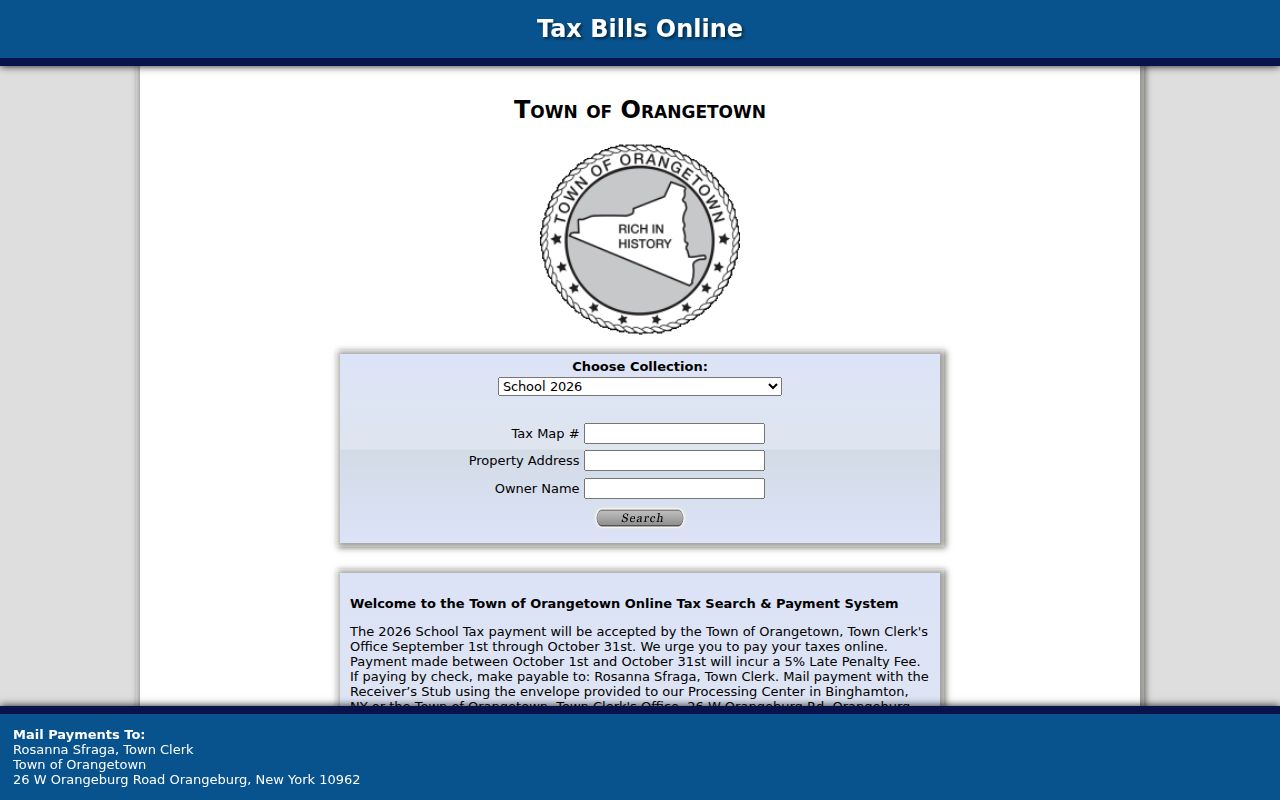
Use the parcel label from BAS as the bridge to a map, deed, assessment roll, or targeted Town request. That bridge is stronger than guessing from a postal label alone.
Orangetown Postal Names Shape Records
Orangetown is a Town with villages, hamlets, former village government, and postal communities. A record may be filed under Nyack, Piermont, Pearl River, Tappan, Sparkill, Blauvelt, Orangeburg, Palisades, or South Nyack rather than under the Town name. Keep the source’s original place label in the research log, then test the modern Town and postal terms as needed. This is especially important near river communities and historical South Nyack.
South Nyack village government dissolved in 2022, and its Justice Court matters moved to Orangetown on April 1, 2022. A court, zoning, clerk, or newspaper search around that change can require both names. Postal geography also differs from municipal authority: 10994 West Nyack is generally a Clarkstown postal context, not an Orangetown neighborhood. An address, Tax Map number, and legal description answer different questions.
Current Orangetown Resident Sources
There is no official all-person directory for Orangetown. Instead, the current sources are role-specific. BAS ties a taxable parcel to owner and bill context. Cott indexes people and entities named in recorded land documents. Court portals identify parties to cases within their coverage. The voter tool serves the voter entering their own information. A license or business filing can confirm an affiliation, but its office or service address is not a home address.
| Source | Who It Lists | Keeper | Access |
|---|---|---|---|
| BAS tax search | Taxable-parcel owners and bill context | Orangetown tax office | Online by owner, address, or Tax Map # |
| Cott land index | Grantors, grantees, lenders, and document parties | Rockland County Clerk | Guest viewing; account and printing rules apply |
| New York voter lookup | A voter’s own registration and polling information | State Board of Elections | Self-service only, not a reverse directory |
| New York court portals | Parties, cases, court, and status where publicly available | New York courts | Separate systems and sealing limits |
| DOS license and entity records | Professional or business affiliation | New York Department of State | Public fields, not residence proof |
Free official records and paid data-compilation services are not interchangeable. Official records show the field and date chosen by the custodian, while compilers may merge old sources, same-name people, and marketing data. Use the official record as the verification point, and ask its custodian how a result was created.
Orangetown Voter Lookup Limits
The New York voter registration lookup asks for county, last name, first name, date of birth, ZIP Code, and address prompts so a registrant can check registration, polling place, and ballot information. It is not a public tool for looking up everyone on a street. A failed match does not show that a person does not live in Orangetown, and a match does not create a public resident profile.
New York Election Law §3-103(5) requires an election-purpose statement for voter-data requests. Confidential registration under Election Law §5-508 and the Address Confidentiality Program can shield eligible records. Public aggregate election statistics can help explain a district, but they do not identify a block’s households or reveal ballot choices.
Note: Registration status can change through address-confirmation and list-maintenance procedures, so it should never be read as a permanent residency finding.
Orangetown Deed Index Trails
The Rockland County Cott portal is the title-history layer. At inspection, its certified-date display showed land records from January 2, 1930 through August 14, 2026 and miscellaneous filings from October 5, 2004 through August 14, 2026. Those are displayed online-coverage snapshots, not the first or last date of all County records. Older books, films, and files belong with the County Clerk or Archives.
For an address trail, copy the latest deed’s recording date, instrument number, grantor, grantee, legal description, and map reference. Search the grantor as an earlier grantee, then compare the parcel and description at each step. A mortgage, satisfaction, lien, or judgment can illuminate a filing history but does not establish that a named person lived on the land. PropertyCheck recording alerts can flag a new name or address recording; they do not replace reading the deed.
Orangetown Court Party Searches
Court records can confirm that a name appeared in a case, not that the person currently resides in Town. WebCivil Supreme offers party, index, attorney, justice, calendar, and document modes with fields for role, court, filing year, status, and output. WebCivil Local serves participating local civil courts, while NYSCEF covers e-filed cases and WebCriminal covers selected courts. Orangetown Justice Court has no verified public Town docket search.
Read a result as a case record: note the parties’ roles, court, filing year, status, appearance, and any disposition. Sealed, matrimonial, mental-hygiene, adoption, juvenile, and youthful-offender material has important access limits. A complaint is an allegation, and a docket is not proof of guilt or a current address. For a paper file, contact the court clerk or the County Clerk’s courthouse and archive routes.
Historical Orangetown Resident Directories
Historical household research is strongest at the New City Library Rockland Room. Its verified directory shelf includes Nyack telephone books from 1883 to 1890, Rockland County telephone books from 1910 to 1998, and Rockland County Cross Reference Directories from 1978 to 1999. The cross-reference run begins with an address and can lead to an occupant or subscriber, then to a name section. It is a dated local snapshot, not a complete history of every household.
The Rockland Room also lists newspapers, federal and state census material, maps, photographs, church and cemetery resources, and genealogical guides. A telephone entry may name a subscriber rather than all people in a residence. Pair it with a deed, obituary, probate matter, or census record before describing an older household. The collections and their access routes are detailed in the Orangetown Directory Book.
The New York State Archives genealogy paths can extend the search to historical census, land, court, naturalization, and local-government material. Its name index can point to a series or box rather than a full biography, and original spelling may control the result. That makes it a route to the next custodian, not a substitute for a dated Orangetown household record.
Orangetown Local History Networks
People and addresses acquire useful context in local repositories. The Nyack Library local-history department holds images, oral histories, postcards, newspaper links, and research contacts for Nyack, Upper Nyack, South Nyack, Grand View, and nearby communities. The Orangetown Museum’s PastPerfect catalogue is a finding aid, with genealogical inquiries and research appointments available. The Historical Society of Rockland and the New York Heritage South of the Mountains collection add county history, community organizations, photographs, and local publications.
Use these resources to test spellings, hamlet labels, business context, or a building’s local story. An oral history or photograph is not proof of a person’s current address. It is a source that can help connect an address to the right newspaper, deed, directory year, or family collection.
Orangetown FOIL Request Routes
When the record is not online, identify the holder before requesting it. The Town Clerk routes Town FOIL requests; the Building Department can search defined permit, certificate, inspection, zoning, or code files by address and date range; the County Clerk and Archives handle different land and court series. A request under the New York Freedom of Information Law, Public Officers Law Article 6, asks for existing records. It does not require an agency to create a new list or answer a research question.
Describe the department, record type, property or person name, approximate date range, and preferred electronic or paper format. Agencies generally must grant, deny, or acknowledge a FOIL request within five business days. If the estimate exceeds 20 business days, the agency must give a reason and date certain. Rockland County’s route also distinguishes standard paper-copy charges from possible electronic-media, preparation, or redaction costs.
Protecting Orangetown Resident Privacy
Some missing results are properly missing. New York’s Address Confidentiality Program under Executive Law §108 can provide eligible participants a substitute legal address and mail forwarding. Confidential voter registration, vital-record eligibility rules, sealed court files, FOIL privacy exemptions, and the federal Driver’s Privacy Protection Act also limit access to specific information. Do not try to reconstruct a protected address from nearby parcel, court, or archive clues.
If a public record contains an error, contact its custodian about the correction or appeal route. A property filing, archival scan, court docket, or voter record is controlled by the office that created or holds it. Personal safety concerns should be routed to the appropriate program or public authority, not solved by posting more information.
Orangetown Vital Record Access Windows
For a birth, marriage, or death connected to Town, first ask whether the Orangetown Town Clerk is the local registrar for the event location. The State Department of Health serves New York State outside New York City and maintains a separate genealogy route. The event location matters more than a person’s later mailing address, and an incorporated village registrar can be a different local route.
New York genealogy copies generally open after 75 years for a birth and 50 years for a death or marriage, subject to the deceased-person and relationship rules explained by the Department of Health genealogy service. A genealogy copy is not a certified record for legal identity use. The current application asks for event and relationship details, so use the live form rather than sending a vague name-only request. The State notes that processing can take eight months or longer; a local registrar can sometimes be a faster route.
Divorce records follow another path. For qualifying events on or after January 1, 1963, the Department of Health can issue a basic divorce certificate, while the decree comes from the court or County Clerk. Certified copies remain subject to eligibility and identification rules. For earlier Orangetown families, the State registration system began in 1880–81 with incomplete early compliance, making church records, cemetery material, newspapers, probate, and local repositories important alternatives.
Orangetown Records Digitization Updates
Town records access is changing in stages. In 2026, Town material described further Building Department digitization work and newly acquired South Nyack records, while Local Law 1-2026 addressed electronic conversion, storage, and GIS information fees. The research does not support a claim that every historic permit or property file is now online. A focused Town request can locate a box, scan, or office-held record that does not appear in a public portal.
Check the current Town notice, form, or portal before relying on any displayed coverage date, fee, or digitization status. Record access improves by series and office, not through one universal Orangetown people search.