
Orangetown Resident Lookup Records
No official source is a complete current-person directory for Orangetown. The useful record trail is divided by purpose. A tax record can connect a name to a taxable parcel; a deed preserves a transfer; a court search reports a party in a case; and a vital record can establish a historical family event. Treat each result as a dated connection, not a biography. The strongest first search depends on whether the known fact is an address, a full name, a past event, or a professional affiliation.
| Record | What It Confirms | Where It Is Kept | Access Route |
|---|---|---|---|
| Tax and assessment record | Taxable parcel owner and tax context, sometimes a mailing address | Orangetown BAS and Town assessment rolls | Online search, roll PDFs, or assessor office |
| Recorded deed | Transfer parties, recording date, legal description | Rockland County Clerk land records | Guest view, account printing, Clerk or Archives copies |
| Court case | Party role, filing, case status, appearances or disposition | New York court portals and the relevant clerk | Portal, public terminal, or case-file request |
| Vital record | Historical birth, death, marriage, or qualifying divorce fact | Town registrar or New York State Department of Health | Eligibility-controlled copy or genealogy request |
| License or entity file | Official professional status or business affiliation | New York Department of State | Public name search, not residence proof |
When only an address is known, begin with the property and deed trail. When only a name is known, test spelling variants in the court and license indexes, then look for an independent parcel or dated historical connection. The New York voter tool has a different role: it lets a registrant check personal registration and polling information, not conduct a third-party resident search.
Defining an Orangetown Resident
Before looking up a resident, label the relationship a record actually supports. A parcel owner may be a trust, estate, office, management company, or person living elsewhere. A tax mailing address can be a useful contact lead, yet it can differ from the parcel's situs address, meaning the location of the land. A court party may have had a local connection on the filing date but not now. A license or corporate record can name an agent, principal office, or credential holder without identifying a home address.
Use plain confidence labels in notes: current parcel owner or tax connection, historical address association, court-party connection, professional or business affiliation, self-confirmed voter lookup, or unverified lead. These labels prevent an old directory entry or a new deed from being presented as proof that someone currently occupies a particular address. They also make conflicting dates easier to resolve.
Note: Preserve the original spelling, mailing label, and record date before normalizing a name or address for a second search.
Two Sources, One Orangetown Identity
A careful Orangetown resident lookup uses convergence, not a single name hit. Seek two independent, time-relevant records that agree on the name plus a street, spouse or relative, parcel, age, business context, or court detail. Normalize variants without erasing the source form. A middle initial, an earlier surname, an abbreviated first name, or a company name can lead to a separate index entry rather than a different person.
- Anchor the exact name to a dated address or parcel through BAS, a roll, or a recorded document when one is available.
- Search the name and reasonable variants in the court portal that matches the likely jurisdiction, then read the party role and case status.
- Use a historical vital index, obituary, probate lead, or license file only to test a shared family, date, or affiliation detail.
- Keep the stronger result with its source date. If the records disagree, report the differing roles and dates instead of choosing the convenient match.
Owner and occupant are the most important distinction. A deed recorded yesterday is strong evidence that a transfer was recorded on that date, but it is weak evidence about who sleeps at the property. Conversely, a historical newspaper notice can place a person at an address in a particular period but cannot prove a present connection.
Orangetown Parcel Clues for Residents
The Town of Orangetown BAS search accepts one route at a time: Tax Map #, Property Address, or Owner Name. The Town's instructions allow a last name alone and recommend ordinary street abbreviations in address searches. Its tax-bill display reaches the past ten years, but it is a tax search rather than a verified live assessor-card database. Assessment-roll PDFs and the assessor office are the next places to ask about a roll entry or exemption context.
Record the tax-map number, the parcel's situs label, displayed owner, tax year, collection, bill status, and any mailing address or value field actually shown. If a name is a trust or estate, the recorded deed may clarify the transfer party and legal description. Rockland's online land-record snapshot displays land records from January 2, 1930 through the current portal snapshot, while earlier material can require the County Clerk or Archives.
| Displayed Field | What It Can Establish |
|---|---|
| Tax Map # | The parcel identifier used to connect the tax result to the GIS map and a deed search. |
| Property or situs address | The location of the land, which is different from proof of a person's current occupancy. |
| Owner display | The owner or tax-related name reported by the source, subject to trust, estate, and entity limits. |
| Tax year, collection, and bill status | The time and tax context for the displayed record. |
| Mailing address, value, or exemption | A field to compare only when shown, not a substitute for a resident identity claim. |
The public tax layer is especially helpful for resolving two people with the same name. It does not identify every household member. A renter, an unlisted phone subscriber, or a person at a protected address may leave no public owner-name trail at all.
Orangetown Court Name Searches
New York court tools are separate indexes with separate limits. WebCivil Supreme has party, index, attorney or firm, justice, calendar, document, and eTrack modes. Its party search offers a name field, role choices, court selection, filing year, open or all status, future-appearance choice, sorting, and HTML or PDF output. Results should be read as cases: index number, type, parties and roles, court, filing year, status, appearance or disposition details, and any document link.
The official WebCivil Supreme party-search screen illustrates why the result role and selected court matter before treating a name match as an Orangetown resident lookup result.
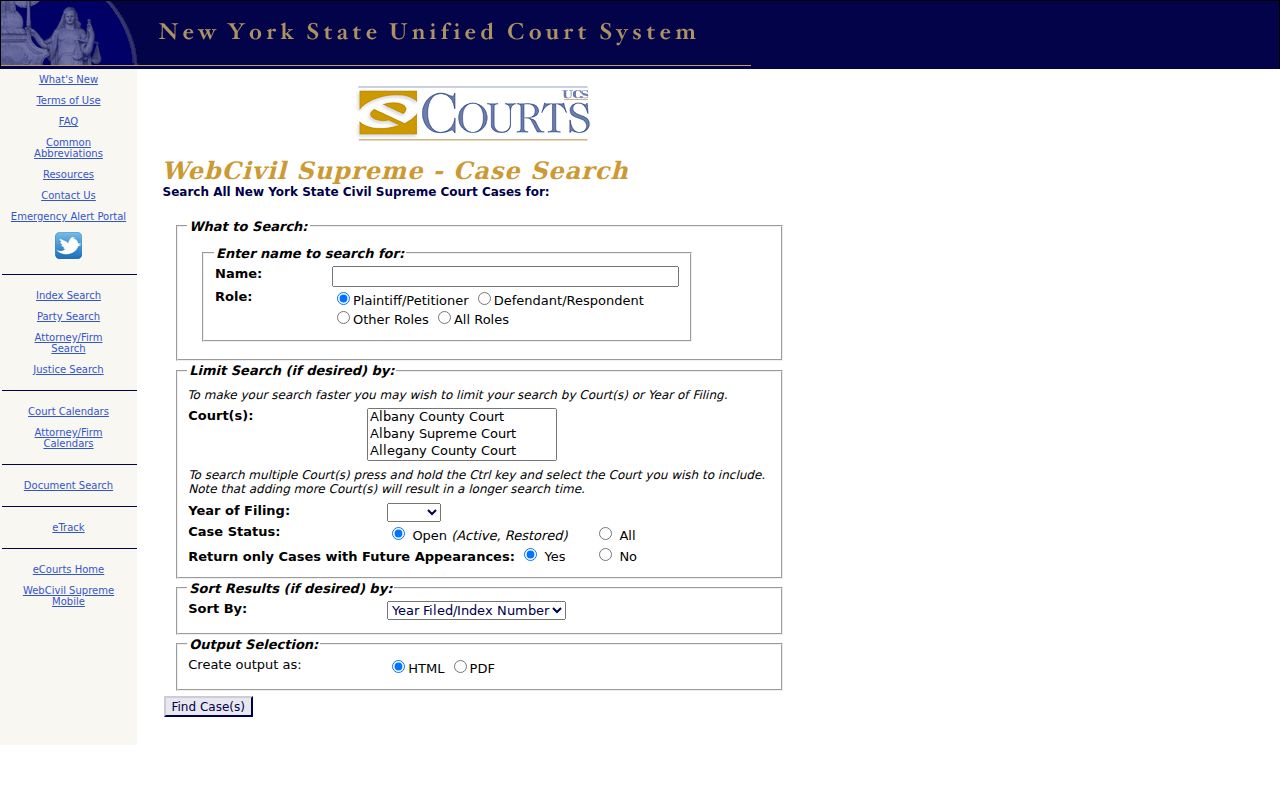
Use the party form to narrow a court case, then confirm a person through an independent record. A docket is the court's running list of events, not proof of the allegations in a filing or proof of current residence.
WebCivil Local separately covers participating local civil courts and searches party name, side, court, case type, filing year, status, future appearances, and output format. For town-level material, include South Nyack terminology for records before its April 2022 transfer. NYSCEF searches e-filed cases as a guest by case identifier, name, case type, county, and filing dates, but an absence there is not an absence from every court file. WebCriminal requires first and last names of at least two characters, covers selected courts, and warns that updates may lag.
Orangetown Court Record Terms
The language on a court or Clerk result can change what a name hit means. The following terms keep the index, the underlying paper, and the form of a copy separate.
- Docket
- The dated sequence of filings, appearances, orders, and other events in a case. It is an event log, not a finding about a person's character or current address.
- Index and image
- An index is the searchable summary that points to a record. An image is the scanned document or page itself and may be restricted, unavailable online, or subject to copy charges.
- Disposition
- The recorded outcome or current procedural result of a case. It is stronger than an allegation, but it still must be read with the correct court and person.
- Certified copy
- A copy authenticated by the custodian. It is obtained from the court or records office when an official certified document is required.
For an actual file, contact the appropriate clerk rather than relying only on a portal. Rockland keeps recent hard-copy County and Supreme Court cases at the courthouse and older files at Archives; the County Clerk lists page and certified-copy charges. Matrimonial, mental-hygiene, youthful-offender, sealed, adoption, and other protected matters have access restrictions.
Orangetown Family History Records
Vital records are historical identity evidence, not a broad current-address index. For an event in the Town, begin by checking whether the Orangetown Town Clerk or a village registrar is the local keeper. The New York State Department of Health genealogy route serves events outside New York City and generally opens births after 75 years, deaths after 50 years, and marriages after 50 years when the relevant people are known deceased. Direct-line descendants may qualify for some earlier access with proof.
A genealogy copy is not a certified identity document. The State's application asks for the subject's name, event date and place, related parent or spouse details, relationship or deceased-person basis, contact information, search period, payment, and affirmation. The published genealogy fee begins at $22 for one to three copies and the Department warns that processing can take eight months or more. A local registrar may be quicker, so confirm the event location before choosing the custodian.
Divorce follows another route. The Department of Health can issue a basic certificate for qualifying post-1963 events, while the decree comes from the court or County Clerk. Eligibility and identification rules apply. For pre-registration Orangetown research, church registers, cemetery records, local newspapers, probate, the Rockland Room, and historical repositories are more realistic than a modern vital-record request.
Orangetown Voter Lookup Boundary
The New York voter registration and poll-site lookup is self-service. It asks for county, first and last name, date of birth, ZIP code, and address details to return a registrant's own registration, poll-site, and ballot information. It is not a public reverse resident directory, and a failed search is not proof that a person does not live in Orangetown. Registration status can also change through address-confirmation and list-maintenance procedures.
The official voter-lookup screen shows the sensitive identity prompts that keep it from working as a general name search for other people.
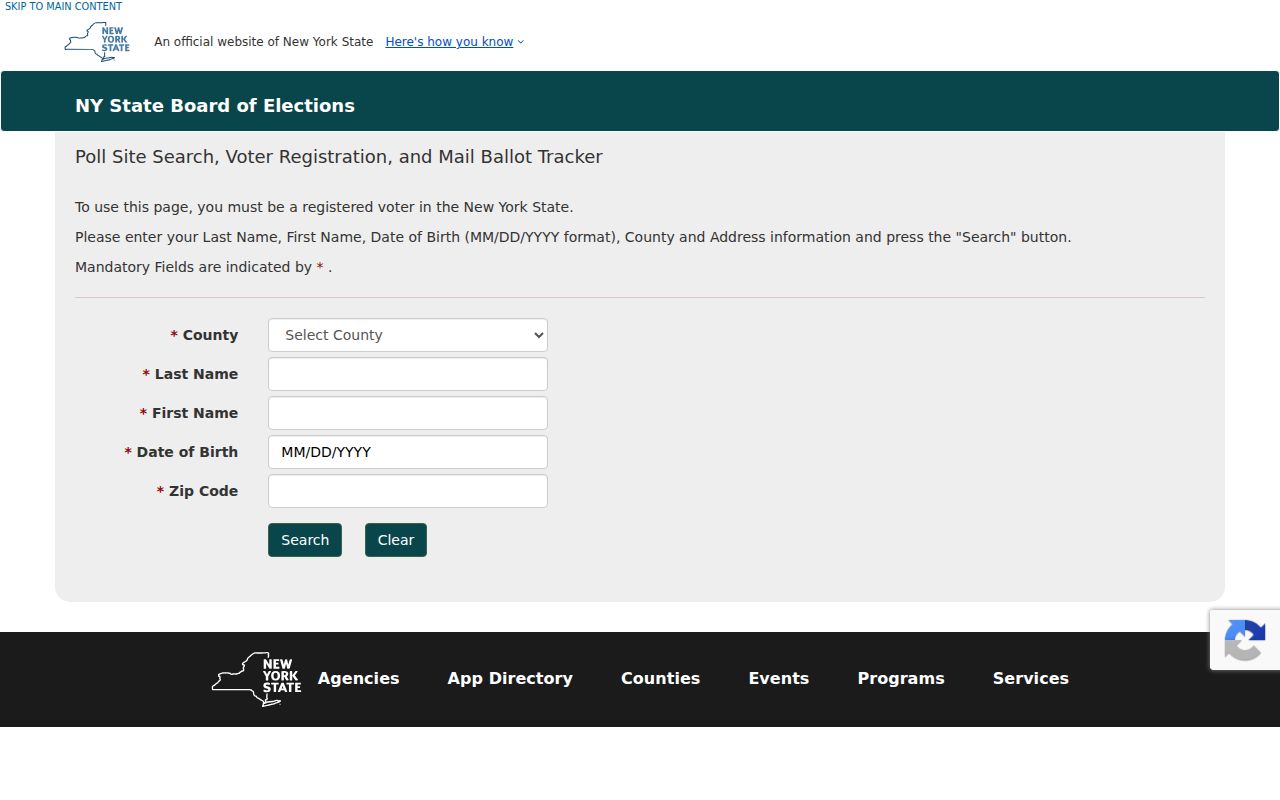
Voter-file research is different from voter self-service. Election Law §3-103(5) requires an election-purpose statement for voter-data requests, and confidential registration under §5-508 plus the Address Confidentiality Program can shield records. Party enrollment is not a ballot choice. Ask the Board of Elections which fields and release limits apply before requesting a defined record.
Orangetown Affiliation Record Limits
A professional or business search can support an affiliation, but it should not be used as residence evidence. The NYS Department of State Licensee Name Search accepts last name, first name, license type, county, city, and ZIP filters and reports active license information. Its inspection did not establish a residence-address result. Some credential families use separate State agency tools.
The Department of State business database can identify an entity, organization date, county location, service-of-process address, agent, current status, and, for some corporations, executive or principal-business details. A service address or principal office is not proof that an officer lives in Orangetown. Use the record's own role label, and compare it with an independently dated parcel, court, or historical result only when the question requires identity confirmation.
Orangetown Records When Search Stops
Official search trails often end with a renter, protected voter, name-only court party, unlisted subscriber, or a person whose postal label differs from Town jurisdiction. Utility customer records and DMV personal addresses are not public alternatives. For a known existing record that is not online, direct the request to the keeper: the Town Clerk, assessor, Building office, County Clerk, Archives, library reference desk, or Board of Elections, depending on the record family.
Orangetown's FOIL route is appropriate for a focused request for an existing agency record, not for a request that staff create an all-residents list. New York's Freedom of Information Law, Public Officers Law Article 6, generally requires a grant, denial, or acknowledgement within five business days. An acknowledgement that extends beyond 20 business days must provide a reason and a date certain. Privacy and other exemptions still apply, and a records office need not create a new compilation to answer a question.
The Rockland County Clerk, Archives, and New City Library's Rockland Room provide additional access for older deeds, court material, directories, newspapers, and microfilm. A narrow name, year range, address, or instrument request gives staff a usable record target and avoids treating a historical collection as a current resident list.
Orangetown Resident Privacy Limits
New York protects more than a search result can reveal. The Address Confidentiality Program under Executive Law §108 provides eligible participants with a substitute legal address and mail forwarding. Confidential voter registration can separate qualifying records from public access. FOIL privacy exemptions, sealed case rules, vital-record eligibility, and the federal Driver's Privacy Protection Act also limit access to personal addresses and other sensitive data. A protected person should not be asked to expose an actual address to correct a public listing.
Lawful use. Use an Orangetown resident lookup for personal, lawful research such as reconnecting, family history, estate questions, or checking a public record. Do not use any result to watch, harass, intimidate, or harm another person.
When a record appears wrong, contact the custodian that created it, ask which field is inaccurate, and use that office's correction or appeal process. Preserve the original source date and response. A paid data-compilation category can be stale, merge same-name people, and lack an official chain of custody, so it cannot replace a dated record from the responsible office.